


Heléna Huhák’s new monograph, published by Indiana University Press, examines the operation of communist propaganda and the everyday practices of political agitation in Hungary between 1948 and 1953.
Titled Making the Hungarian Communist: Political Agitation, Mass Mobilization, and Everyday Life, 1948–1953, the book appears in the publisher’s Studies in Hungarian History series. It was translated into English by David Robert Evans.
The monograph explores how communist propaganda became embedded in the everyday lives of ordinary people during the early Stalinist period. It examines how the Hungarian Workers’ Party, following Soviet models, organized a network of agitators whose task was to disseminate communist ideology, mobilize the population politically, and report local observations and experiences back to the party leadership.
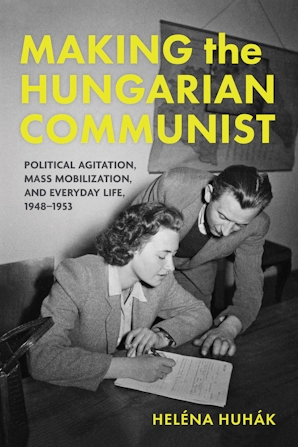
Drawing on extensive archival research and personal interviews, the book analyzes the formation of the agitators’ network, their training, and their everyday activities. Particular attention is devoted to the ways agitators connected the party’s ideological messages to people’s lived experiences and to how the boundaries between political issues and private life gradually became blurred. Heléna Huhák also demonstrates that political agitation was far more than a one-way instrument of propaganda: people’s homes became spaces for advocacy, complaint, and negotiation, in which the party and the citizens it sought to influence shaped one another’s relationship.
By focusing on the interactions between local party functionaries and ordinary citizens, the monograph offers a new perspective on the operation of communist propaganda. It shows that the practices of political agitation not only shaped society but were themselves transformed by the experiences, interests, and everyday interactions of both agitators and the people they sought to persuade.
The volume is part of the Studies in Hungarian History series, which publishes significant works of scholarship on Hungarian history for an international audience. The series is edited by László Borhi, Research Professor at the Institute of History, ELTE Research Centre for the Humanities, and Professor at Indiana University.
The book has received high praise from internationally renowned historians, who highlight its innovative approach, meticulous archival research, and its focus on communist propaganda through the everyday experiences of local agitators and the people they addressed. According to the reviewers, the volume offers a nuanced understanding of social relations during Hungary’s Stalinist period and makes an important contribution to the international historiography of communist dictatorships.


